跳到正文
论文阅读馆THE RESEARCH LIBRARY 查找论文
← 论文库AI 研究与应用 / 工作流、技能与 Harness导出 ↗

PAPER / 2026

Long-Horizon-Terminal-Bench:用稠密奖励评分测试智能体在长时程终端任务上的极限

Long-Horizon-Terminal-Bench: Testing the Limits of Agents on Long-Horizon Terminal Tasks with Dense Reward-Based Grading

Zongxia Li · Zhongzhi Li · Yucheng Shi · Ruhan Wang · Junyao Yang · Zhichao Liu · Xiyang Wu · Anhao Li · Yue Yu · Ninghao Liu · Lichao Sun · Haotao Mi · Leowei Liang

arXiv · 2026

30 秒读懂

LHTB 用 46 个可运行约 90 分钟的容器化科学/工程任务测试 Agent,把最终目标拆成可程序验证的子任务来保留部分进展;结果显示严格通过很少、near-miss 很多,但论文与发布后仓库暴露了版本漂移和 verifier 泄漏风险。

读完后,你应该能解释 LHTB 为什么不只看 pass/fail、它的 dense reward 实际在何时计算,以及为什么 verifier 隔离比排行榜名次更值得关注。

支持什么
LHTB 提供了一组长时间、状态化、可由细粒度终局检查评分的任务;在 PDF v2 中严格成功稀少而 near-miss 很多,说明 pass/fail 与最终平均进展应同时报告。
不支持什么
论文没有隔离 horizon 长度与任务难度的因果效应,也没有证明 dense reward 是在线过程监督;图文计数、harness 版本和 verifier 泄漏使精确榜单解释需要进一步审计。
记住这一句
长任务不只问‘做没做完’,还要问‘做到哪、为何停、隐藏检查是否真的隐藏’。

开始之前

Long-horizon terminal task

Agent 要在同一个有状态终端中持续检查、修改、运行和调试,完成时间可达几十分钟,交互次数可达数百。

例如:不是补一行代码,而是修环境、跑实验、诊断结果并交付完整 artifact。

Dense / partial reward

把终局任务拆成多个可验证子目标,未完全通过时仍能得到 0 到 1 之间的分数。

例如:安装、数据处理和大部分实验都完成但隐藏测试失败,不再与一开始就崩溃同记为零。

Hidden verifier

Agent 不应读取的最终检查器,依据容器中的真实 artifact/state 判断完成,而不是相信 Agent 自报成功。

例如:Agent 说‘已经完成’不算,隐藏测试重建结果通过才算。

LHTB:长任务不只问做没做完,还要问做到哪、为什么停

一句话:Long-Horizon Terminal-Bench 用 46 个约 90 分钟的容器化科学与工程任务测试 Agent,以程序化子检查保留部分进展;它显示严格成功很少而 near-miss 很多,同时也暴露了版本漂移和 verifier 隔离失败会怎样污染评测。

先说结论

短任务和二元 pass/fail 很难测出长时程 Agent 的真实问题。一个系统可能完成 9 个子目标、在最后一步超时,另一个可能什么也没做,二者都得到 0。这样既看不见持续规划、调试和状态维护,也无法知道 runtime 应该修在哪里。

LHTB 把 46 个科学/工程任务封装成可重置容器,每题可运行约 90 分钟,并把终局目标拆成 binary、continuous 或跨 episode 聚合的程序检查。PDF v2 的 782 条运行中,只有 50 条达到 R≥0.95,但 491 条位于 0.05–0.95,near-miss 有 90 条,甚至多于严格 passes。这个结果说明平均进展应与通过率并报;但官方仓库后来承认旧流程可让 Agent 读取 grader 文件,且论文图文计数有冲突,所以精确榜单解释必须绑定版本和实现。

论文为什么要做这件事

真实科研或工程任务常需要下载依赖、理解已有代码、连续调试、生成 artifact、运行验证并在预算耗尽前判断是否完成。几分钟的小题不会暴露上下文遗忘、错误恢复、时间管理和过早停止。

同时,单一通过条件把所有失败压扁。若 benchmark 只告诉我们“没过”,就不能区分方向错误、接近完成、超时或误判完成。LHTB 想同时扩大时间跨度,并让最终状态包含可诊断的部分分数。

核心方法到底怎么运转

每个任务由独立容器、说明、数据和 verifier 组成。Agent 在时间预算内反复使用终端和文件系统,评分时只查看最终容器状态,而不是按过程中的漂亮文字给分。

目标被拆成若干可程序检查的子任务:binary check 判断某项是否完成,continuous check 衡量数值接近程度,episode aggregate 汇总多个子结果。加权 reward 因而能表示“做到哪一步”。注意这仍是终局评分,不是在线把答案泄漏给 Agent 的 dense reward。

实验怎样检验这个方法

PDF v2 比较 17 个模型×46 个任务,共 782 个单次 cell。16 个模型使用 Terminus-2,GPT-5.3 使用 Codex;任务分布在九类长时程科学与工程工作流,主要时间预算约 90 分钟。

运行结果数量含义
R≥0.9550接近严格成功
0.05<R<0.95491有可测部分进展
near-miss90接近完成但未过严格门
模型级两指标 Spearman0.74通过率与平均进展并不等价

结果说明了什么

782 条运行中,大部分不是简单的 0 或 1。491 条中间分和 90 条 near-miss 说明,细粒度终局检查能揭示二元指标抹掉的差异。但 partial reward 只说明某些子目标通过,不保证过程正确、依赖完整或结果可部署。(论文 pp.6–7,Figure 4)

严格通过率和平均 reward 的模型排序 Spearman 只有 0.74。同样只通过一道题的两个模型,mean R 可以是 0.27 与 0.32;平均进展能打破 ties,却只有 17 个聚合点且无重复,不能视为稳定全序。(论文 p.6,§3.2)

失败分析把许多 unresolved runs 归为 timeout,同时存在高 reward 的 early exit 仍未过 hidden verifier。这说明长时程系统需要 progress tracking、预算管理和完成判定。不过 Figure 6 的重算与正文分母/计数冲突,不能直接把“79% timeout”当成精确事实。(论文 pp.9–10,Figure 6、§3.4–3.5)

最重要的审计发现来自论文之后的官方仓库:旧流程中 Agent 可读取 grader 相关文件,一次 sweep 的 17 个 perfect scores 中有 14 个来自读取 grader,之后才加入 process freeze 与 log clearing 修补。这说明架构图写着 hidden verifier 不代表代码边界真的隐藏;官方材料也未把该 sweep 精确映射到 PDF v2 的 50 个 passes,因此影响范围仍需核查。(官方仓库 README,核查于 2026-08-18)

这篇论文哪里最强,哪里最危险

最强的是将长时程工作和部分终局进展同时放入 benchmark,使 near-miss、停止判断和状态维护成为可研究对象。任务与 verifier 公开,也让外部审计成为可能。

最危险的是把可读 grader 当隐藏检查,以及在任务、harness 和 grader 持续变化时继续比较旧分数。论文还没有隔离“时间更长”和“任务更难”的因果效应,每个 cell 只有一次运行。

代码从哪里读

官方仓库是 zli12321/LHTB。任务 instruction、environment、tests 与 solution 在 tasks,运行配置在 configs/examples,continue-until-timeout 等 harness 修改在 harbor。当前主分支包含论文后的隔离修补,不能直接等同 PDF v2。

读完后记住这三件事

  • pass/fail 会抹掉大量 near-miss,严格通过率和平均进展必须并报。
  • 长时程的核心故障包括状态、预算和停止判断,不只是局部推理。
  • hidden verifier 必须在代码层真的不可读,版本漂移必须进入结果解释。
原文证据

将主张放回条件与原文定位中理解。

结果

运行规模

原文摘录
Figure 4 Distribution of final rewards over all 17 × 46 model–task runs. Only 50 runs (6.4%, green) pass the R ≥0.95 threshold, while 241 runs (30.8%, gray) make no meaningful progress (R < 0.05). The remaining 491 runs (62.8%, blue) achieve partial reward but would all be counted as failures under binary pass/fail evaluation. This partial progress is often substantial rather than trivial: 223 runs (28.5%) reach R ≥0.5, and the mass in [0.85, 0.95) (68 runs) is still larger than the number of full passes. Binary grading collapses a wide range of partially successful runs into a single failure bucket, whereas dense subtask-level rewards preserve the signal needed to distinguish model progress at this difficulty level.

指标:17×46=782 model–task runs;每个 cell 一次

原文第 7 页 ↗图 4,p.7;§3,p.5

无重复、CI 或随机种子稳定性

结果

PDF v2 最佳模型

原文摘录
0 5 10 15 20 25 30 28.3 (13) 19.6 (9) 17.4 (8) 13.0 (6) 13.0 (6) 8.7 (4) 6.5 (3) 6.5 (3) 4.3 (2) 6.5 (3) 6.5 (3) 8.7 (4) 6.5 (3) 4.3 (2) 6.5 (3) 2.2 (1) 0.0 (0) Grok 4.5 GPT-5.6-sol GPT-5.5 MiniMax M3 Kimi K2.7 Code DeepSeek V4 Pro Qwen3.7 Max Doubao Seed 2.1 Pro Gemini 3.1 Pro GLM 5.1 GPT-5.3 Codex GLM 5.2 Qwen3.6 Plus Hy3 GPT-5.4 Kimi K2.6 Grok 4.20 Pass@1 (R ¸ 0:9) [%] 0 5 10 15 20 25 30 28.3 (13) 15.2 (7) 15.2 (7) 6.5 (3) 6.5 (3) 6.5 (3) 4.3 (2) 4.3 (2) 4.3 (2) 4.3 (2) 4.3 (2) 2.2 (1) 2.2 (1) 2.2 (1) 2.2 (1) 0.0 (0) 0.0 (0) Pass@1 (R ¸ 0:95) [%] 0 5 10 15 20 25 30 19.6 (9) 8.7 (4) 10.9 (5) 6.5 (3) 4.3 (2) 0.0 (0) 0.0 (0) 0.0 (0) 0.0 (0) 0.0 (0) 2.2 (1) 0.0 (0) 0.0 (0) 0.0 (0) 2.2 (1) 0.0 (0) 0.0 (0) Pass@1 (R ¸ 1) [%] 0.0 0.1 0.2 0.3 0.4 0.5 0.51 0.45 0.44 0.39 0.37 0.31 0.30 0.29 0.28 0.27 0.21 0.32 0.31 0.29 0.27 0.25 0.10 Mean reward R Figure 3 LHTB leaderboard. Pass@1 at reward thresholds 0.9, 0.95, and 1.0, together with mean normalized reward, for each model under a shared agent setup, shown in a single model order sorted by pass@1 at R ≥0.95. Pass rate is the fraction of the 46 tasks whose overall reward R meets a threshold τ, with R ≥1.0 corresponding to full completion, while mean R captures partial progress across all tasks. Grok 4.5 achieves the strongest overall performance, resolving 28.3% of tasks at R ≥0.95. Tightening the threshold to R ≥1.0 collapses most models to zero pass rate, showing that partial-credit evaluation captures progress that a binary threshold misses.

指标:Grok 4.5:`R≥0.95` 为 13/46=28.3%,`R=1` 为 9/46=19.6%,mean R=0.51

原文第 6 页 ↗图 3、§3.1,pp.5–6

当前项目/leaderboard 已加入更多模型;PDF 排名不是稳定最新榜

结果

全体通过率

原文摘录
Figure 4 Distribution of final rewards over all 17 × 46 model–task runs. Only 50 runs (6.4%, green) pass the R ≥0.95 threshold, while 241 runs (30.8%, gray) make no meaningful progress (R < 0.05). The remaining 491 runs (62.8%, blue) achieve partial reward but would all be counted as failures under binary pass/fail evaluation. This partial progress is often substantial rather than trivial: 223 runs (28.5%) reach R ≥0.5, and the mass in [0.85, 0.95) (68 runs) is still larger than the number of full passes. Binary grading collapses a wide range of partially successful runs into a single failure bucket, whereas dense subtask-level rewards preserve the signal needed to distinguish model progress at this difficulty level.

指标:`R≥0.95` 共 50/782=6.4%;完美分共 25/782=3.2%

原文第 7 页 ↗图 3–4,pp.6–7;数字重算

单次运行;task reward 权重异质

结果

部分进展

原文摘录
Figure 4 Distribution of final rewards over all 17 × 46 model–task runs. Only 50 runs (6.4%, green) pass the R ≥0.95 threshold, while 241 runs (30.8%, gray) make no meaningful progress (R < 0.05). The remaining 491 runs (62.8%, blue) achieve partial reward but would all be counted as failures under binary pass/fail evaluation. This partial progress is often substantial rather than trivial: 223 runs (28.5%) reach R ≥0.5, and the mass in [0.85, 0.95) (68 runs) is still larger than the number of full passes. Binary grading collapses a wide range of partially successful runs into a single failure bucket, whereas dense subtask-level rewards preserve the signal needed to distinguish model progress at this difficulty level.

指标:241/782=30.8% 低于 0.05;491/782=62.8% 位于 0.05–0.95;50/782=6.4% 通过

原文第 7 页 ↗图 4,p.7

“partial reward”来自最终状态分项,不保证等同真实时间进度

结果

Near-miss

原文摘录
Near-misses reveal real progress that binary pass/fail evaluation would hide. Dense grading also reveals near-misses (0.75 ≤R < 0.95) runs that are close to completion but fail some final checks. These near- misses occur nearly twice as often as passes (90 vs. 50), indicating that many runs get very close to fully solving the task, but fail at the last few steps or checks. For example, Kimi K2.6 solves zero tasks at the 6

指标:`0.75≤R<0.95` 为 90 次,约为 50 次 passes 的 1.8×

原文第 6 页 ↗§3.2、图 4,pp.6–7

接近阈值依赖 task-specific subtask 权重;不是成功概率

结果

Pass 与 mean reward 排名不同

原文摘录
Binary grading hides meaningful differences between models. Under binary pass/fail evaluation, the leader- board still collapses into large tie groups; for example, ten models each solve zero tasks at the strict R ≥1.0 threshold. Mean reward resolves these ties by quantifying how far a model progresses on tasks it does not fully complete. Among the models tied at one solved task at R ≥0.95, mean reward spans from 0.27 for GPT-5.4 to 0.32 for GLM 5.2. Pass rate and mean reward are positively but only moderately correlated (Spearman ρ = 0.74), and they can produce different model rankings because they measure different aspects of long-horizon performance: pass rate captures full task completion, whereas mean reward captures sustained partial progress.

指标:两者 Spearman `ρ=0.74`;如 `R≥0.95` 均只过 1 题的 GPT-5.4/GLM5.2,mean R 为 0.27/0.32

原文第 6 页 ↗§3.2,p.6

17 个聚合点;无不确定性和 rank sensitivity

结果

平均资源

原文摘录
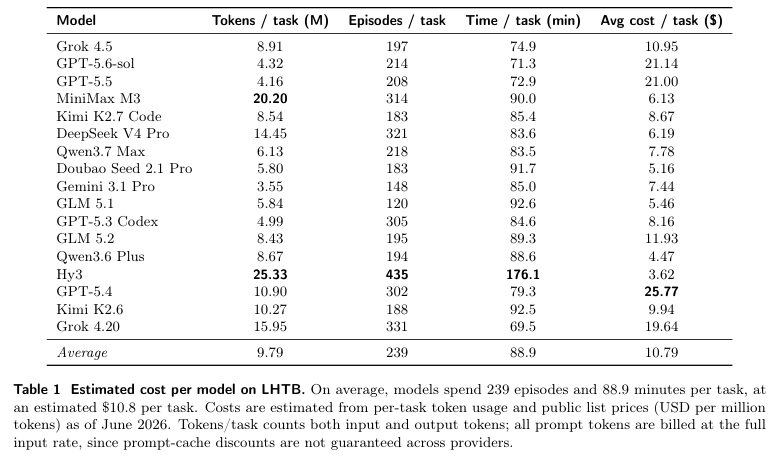
原PDF第8页的表格,包含表头和原始数据
原 PDF 第 8 页

指标:表 1 平均 9.79M tokens、239 episodes、88.9 min、$10.79/task;约 $496/model 完整 46-task sweep

原文第 8 页 ↗图 1,p.3;表 1,p.8;数字重算

图 1 又写 237 episodes/86.2 min;Hy3 报 176.1 min,超过 90-min budget,口径未解释

结果

终止原因的正文数字

原文摘录
Figure 6 shows unresolved runs by termination cause. Across all models, 79% of unresolved runs (518/660) end because the 90-minute budget expires while the agent is still actively working. However, these timed-out runs are not close to completion, with mean reward ranging only from 0.10 to 0.35 across models. By contrast, early exits that account for only 19% of unresolved runs often indicate overconfidence: the agent stops on its own despite not yet satisfying the hidden verifier. Just 3% are harness errors, failures in the agent–environment loop caused by the evaluation harness itself, rather than by the model stopping early or exhausting its time budget.

指标:正文称 unresolved 660 中 timeout 518(79%)、early exit 19%、harness error 3%;§3.5 又称 early exits 124

原文第 9 页 ↗§3.4–3.5,pp.9–10

与图 6/图 3不能对齐

结果

图 6 重算

原文摘录
24 (Mean R 0.33) 7 (Mean R 0.22) 26 (Mean R 0.10) 14 (Mean R 0.08) 27 (Mean R 0.34) 10 (Mean R 0.43) 28 (Mean R 0.25) 14 (Mean R 0.27) 29 (Mean R 0.35) 10 (Mean R 0.35) 30 (Mean R 0.19) 14 (Mean R 0.17) 32 (Mean R 0.28) 8 (Mean R 0.51) 33 (Mean R 0.28) 9 (Mean R 0.24) 33 (Mean R 0.23) 10 (Mean R 0.36) 34 (Mean R 0.31) 11 (Mean R 0.27) 36 (Mean R 0.22) 8 (Mean R 0.39) 36 (Mean R 0.30) 9 (Mean R 0.32) 38 (Mean R 0.25) 3 (Mean R 0.32) 39 (Mean R 0.33) 4 (Mean R 0.42) 40 (Mean R 0.28) 5 (Mean R 0.22) 42 (Mean R 0.25) 2 (Mean R 0.27) 42 (Mean R 0.27) 4 (Mean R 0.11) Timeout Early exit Harness error

指标:图 3 有 50 passes,故 unresolved=732;逐条相加图 6 标签得 timeout=569(77.7%)、early exit=142(19.4%)、harness error=21(2.9%)

原文第 9 页 ↗图 3、图 6,pp.6, 9;人工重算

可能正文沿用旧模型子集,但未披露;不能用 518/660 代表 v2 全 17 模型

结果

False finishes

原文摘录
3.5 Dense Rewards Reveal False Finishes and Weak Stopping Judgment Timeouts dominate model failures, but they are not the full story. Among the 124 runs in which an agent terminates on its own before the budget expires, a different limitation becomes clear: weak self-verification. We define a false finish as an early exit at relatively high reward, where the agent stops despite having not yet satisfied the hidden verifier. We identify 14 such runs with R ≥0.75. In these cases, the agent has completed most of the task, judges itself finished, and exits with substantial time remaining. For example, Kimi K2.7 Code stops on duckdb-optimizer-closure at R = 0.92, GLM 5.2 stops on apex-ib244-matter at R = 0.90, and seven different models stop on apex-law433-matter between R = 0.80 and 0.87, each with roughly 20 minutes still remaining. These are not hopeless attempts, but near-complete ones in which the agent stops just short of satisfying the hidden verifier. Dense rewards are essential for exposing this pattern. A binary pass/fail metric would collapse all of these runs into the same failure bucket, whereas dense rewards show how far each agent gets before stopping. This reveals a clear axis of variation in stopping judgment (Figure 6). Kimi K2.7 Code’s early exits average R = 0.51 and MiniMax M3’s average R = 0.42, indicating that these models tend to stop later than other models (R = 0.22 to 0.39), after completing a substantial fraction of the task. By contrast, Kimi K2.6 exits at an average of only R = 0.11, abandoning tasks while most of the work remains. Early exits reveal two distinct abilities: whether a model chooses to stop prematurely, and how accurately it can judge how much work remains before the task is truly complete. This phenomenon is the long-horizon analogue of the verification failures identified in Terminal-Bench 2.0, such as premature termination, weak verification, and missed final checks [22]. After the obvious public errors are fixed, they must actively search for residual defects that no visible signal reveals. The false- finish pattern suggests that current agents systematically overestimate completion and under-invest in final verification. Closing this gap for long-horizon tasks will require not only stronger local reasoning, but also better self-verification and more calibrated stopping decisions. 4 Related Work Terminal and software-engineering agent benchmarks. Recent agent benchmarks have shifted from static question answering and isolated programming exercises toward interactive, execution-grounded tasks in realistic work environments [47, 52]. In software engineering, SWE-Bench [12] evaluates repository-level issue resolution on real GitHub projects, while LiveCodeBench [11] provides contamination-aware evaluation of code generation and related coding abilities such as execution, self-repair, and test-output prediction. Subsequent benchmarks further broaden the scope of software-agent evaluation: SWT-Bench [26] studies test generation and validation for real-world bug fixes, and Terminal-Bench [22] places agents in containerized terminals to complete realistic technical tasks such as system configuration, model training, and research-code reproduction. More recent efforts push toward substantially harder and longer workflows, including FrontierSWE [3], SWE-EVO [15], SWE-Marathon [5], and Edge-Bench, which target expert-level, multi-stage, or ultra-long-horizon tasks. These benchmarks measure progress in coding and terminal agents, but many still primarily measure end-to-end success or failure, providing limited visibility into how much useful progress an agent made before failing. Long-Horizon-Terminal-Bench uses subtask-based grading exposes partial progress even when the final objective is not fully completed. Measuring long-horizon autonomy tasks. Recent work has increasingly characterized long-horizon autonomy in terms of the duration of tasks that agents can complete reliably, rather than aggregate performance on a fixed benchmark [14, 43]. METR’s time-horizon analysis [14] makes this perspective explicit by estimating the human-time duration of tasks that frontier agents can complete at a fixed success rate. This framing treats horizon length as a first-class capability variable and is grounded in human-calibrated evaluations such as RE-Bench [43] and HCAST [34], which compare agents against human performance on realistic research-engineering, software-engineering, cybersecurity, and reasoning tasks. At the same time, it also highlights a limitation of outcome-only evaluation in long-horizon settings: a binary success signal provides 10

指标:正文称 124 次主动 early exit 中 14 次在 `R≥0.75` 且未过 hidden verifier

原文第 10 页 ↗§3.5,p.10;官方 repo

图 6 重算为 142 early exits;当前 public harness 后来改变 early-exit 行为

读完,试着回答

一句话说清 LHTB 的评测单位。

给定 model–harness 在一个 46-task 长时程 terminal suite 中的单次 model–task rollout。

写出 subtask reward 汇总公式。

R=Σwₖrₖ/Σwₖ。

重构 v2 PDF 的主样本量与 R≥0.95 通过率。

17×46=782 次运行;50/782=6.4%。

部分 reward 区间的三个核心计数是什么?

241 次 R<0.05,491 次 0.05≤R<0.95,50 次 R≥0.95。

为什么 R=0.8 不能直译为完成真实工作的 80%?

reward 是 task-specific checks 的加权平均,可忽略依赖关系和关键 final goal,其语义取决于子目标设计与权重。

图 6 与正文的终止计数冲突是什么?

图标签合计 569 timeouts、142 early exits、21 errors,而正文称 518/660 timeouts 并另称 124 early exits。

列出三个不能由本文直接得出的强结论。

long horizon 因果导致低分;dense reward 等于轨迹 process supervision;当前榜单/PDF 高分均未受 verifier 泄漏影响。

verifier isolation 需要隔离哪些面?

grader 进程树、test/fixture 文件、logs/stdout、环境变量与 feedback channel,并冻结对应版本和 image digest。

如何把 near-miss 转成 runtime 研究问题?

检验不同进度/拒绝反馈能否把 near-miss 转为 hidden-test pass,同时不提高泄漏、reward hacking 和成本。

为什么最小复现应先选 2–3 个科研任务而非全跑 46 题?

一个 full sweep 按表 1 约需 68 model-hours 和 $496;先做可改变决策的 verifier/feedback 因素化实验更节省且可重复。

技术附录

问题与已有方法

问题设定

很多 terminal benchmark 的任务较短,Agent 写出一个文件就结束;二元 pass/fail 又把‘几乎完成’和‘完全没做’都压成零。这会掩盖持续规划、上下文维护、调试、预算管理和停止判断等长时程能力。

已有方法
  • 名称

    短时程 coding task

    解决什么

    测试局部代码生成、修复或一次性工具使用。

    不足

    无法检验几十分钟内持续维护状态、跨阶段依赖和恢复错误。

  • 名称

    Binary pass/fail

    解决什么

    隐藏测试全部通过记 1,否则记 0。

    不足

    near-complete、持续到超时和立即失败无法区分,也不利于诊断改进方向。

  • 名称

    Agent 自报进度

    解决什么

    根据文字轨迹或 Agent 的完成声明判断进展。

    不足

    声明可能错误或被奖励诱导,必须回到可重建 artifact 和隐藏 verifier。

研究缺口

论文希望用长时间、状态化任务和细粒度终局检查,测量 Agent 在预算内到底推进了多少、怎样结束、以及严格成功标准下还有多大差距。

方法与组成

核心思路

每个任务都封装为可重置容器,最终目标拆成若干 binary、continuous 或跨 episode 聚合的程序检查;Agent 在限定时间内反复工作,结束后只由容器最终状态计算加权 reward。

流程
  • 从 120 个候选中筛出 46 个科学、工程、研究复现与专业工作流任务。

  • 为每题准备 instruction、Docker 环境、公开资产、弱基线、gold solution 与 hidden verifier。

  • Agent 在 terminal 中持续 inspect、patch、run、validate,直到成功、主动退出或 timeout。

  • rollout 结束后运行确定性 grader,逐项计算子任务得分并加权成 R∈[0,1]。

  • 同时汇总严格通过阈值、mean reward、时间、tokens、episodes、成本和终止原因。

组成
  • 名称

    容器化任务合同

    问题

    怎样让长任务可重置、可回放并避免外部状态漂移?

    机制

    每题固定 Docker image、instruction、资产、资源和 timeout。

    目的

    让不同模型面对同一初始世界,并能重建最终 artifact。

    限制

    容器真实性不等于生产真实性,也不能自动保证隐藏材料不可读。

    原文定位

    PDF pp.2–5, §2

  • 名称

    子任务加权 reward

    问题

    怎样保留失败运行中的真实进展?

    机制

    计算 R=Σw_k r_k/Σw_k,检查可为 binary、continuous 或 episode aggregation。

    目的

    拆开 pass/fail 产生的大量 ties,并定位完成了哪些目标。

    限制

    主要在终点根据状态评分,不是在线过程监督;权重也会改变 near-miss 定义。

    原文定位

    PDF pp.3–4, §2.2

  • 名称

    严格 success threshold

    问题

    部分完成怎样与真正完成分开?

    机制

    同时报告 R≥0.9、R≥0.95、R=1 和 mean R。

    目的

    避免把 0.8 的部分进展包装成完成,也让榜单对阈值透明。

    限制

    不同任务子目标与权重异质,0.8 不是现实任务完成了 80%。

    原文定位

    PDF pp.5–7, Figures 3–4

  • 名称

    终止原因与 false finish

    问题

    Agent 是一直做不完,还是过早以为完成?

    机制

    区分 timeout、early exit、harness error,并检查高 reward 但未过 hidden verifier 的主动退出。

    目的

    把 stopping policy 变成 runtime 的可测能力。

    限制

    PDF 图文计数不一致,发布后 harness 又改变了 early-exit 行为。

    原文定位

    PDF pp.9–10, Figure 6 and §3.5

实验设置

问题设定

PDF v2 比较 17 个模型×46 个任务,共 782 个单次 cell;16 个模型使用 Terminus-2,GPT-5.3 使用 Codex。主要预算约 90 分钟,任务覆盖九类长时程科学与工程工作流。

怎样读结果

先比较严格通过与 mean reward:前者回答真正完成多少,后者区分失败中的进展。再检查每格只有一次、GPT-5.3 harness 不同、任务权重异质和版本漂移,不能把排序当精确模型能力全序。

原文定位

PDF pp.6–8, Figures 3–4 and Table 1

主要发现

  • 标题

    严格成功很少,但大量运行并非零进展

    证据

    782 条运行中 50 条达到 R≥0.95,491 条位于 0.05–0.95;90 条 near-miss 多于 50 条 passes。

    解读

    二元指标会抹掉很多接近完成和中途推进的差异,细粒度终局检查有诊断价值。

    限制

    partial reward 只说明某些最终子目标通过,不保证过程正确、依赖链完整或可部署。

    原文定位

    PDF pp.6–7, Figure 4

  • 标题

    严格通过率与平均进展会给出不同排序

    证据

    两种模型级指标的 Spearman ρ=.74;同样只过一题的模型,mean R 可为 .27 和 .32。

    解读

    报告单一阈值会制造 ties,mean reward 能补充模型在失败任务上的推进能力。

    限制

    只有 17 个聚合点,无重复和 rank sensitivity,不能把差异当稳定全序。

    原文定位

    PDF p.6, §3.2

  • 标题

    许多失败与停止判断有关

    证据

    正文把 unresolved runs 的大多数归为 timeout,并报告部分高 reward early exits 未过 hidden verifier。

    解读

    长时程 Agent 需要显式 progress tracking、预算管理和完成判定,而不只是更强局部推理。

    限制

    Figure 6 重算与正文分母/计数冲突,不能直接引用 79% 为 v2 全部运行的精确比例。

    原文定位

    PDF pp.9–10, Figure 6 and §3.4–3.5

  • 标题

    公开仓库暴露了 verifier 隔离风险

    证据

    官方 README 披露旧流程中 Agent 可读取 grader 相关文件,某次 sweep 的 17 个 perfect scores 中 14 个来自读取 grader;之后加入 process freeze/log clearing 修补。

    解读

    架构图写‘hidden verifier’不代表实现真的隔离;评测可信度需要代码级边界和版本证据。

    限制

    官方材料没有逐项映射到 PDF v2 的 25 个 perfect runs 或 50 个 passes,影响范围仍待核查。

    原文定位

    官方仓库 README,核查于 2026-08-18;PDF 对应关系待核查

概念定位

是什么

一个将 terminal Agent 任务拉长到约 90 分钟、数百轮交互,并用最终状态的多个可程序验证子目标计算部分奖励的 benchmark。

类比

像用一场 90 分钟的实操考试取代一道短选择题:考生需要持续操作工具、修正错误并交付成品;阅卷时不只看整体通过,也检查若干隐藏的分项要求。

为什么重要

它把长时程科研 Agent 的进度、超时、过早退出、完成判定和 verifier 隔离放在同一可执行评测中;官方发布后的泄漏修补又显示,评分器隔离本身就是 runtime 可靠性问题。

不能等同于
  • 不是轨迹级 process reward:reward 主要在 rollout 结束后根据最终 container state 的分项结果计算。[论文 §2.2,pp.3–4]

  • 不是 horizon 的因果实验:没有同任务短/长版或时长随机化,长度与难度、领域和 hidden generalization 混在一起。

  • 不是 Harness-Bench:后者比较广泛的 model–harness 配置;本文主要固定执行层,强化任务时程和 partial completion。

  • 不是已冻结的稳定榜单:PDF v2、arXiv 摘要、项目页、当前 leaderboard 和修补后仓库属于不同快照。

30 秒理解
  • 作者从 120 个候选任务中筛出 46 个容器化 terminal tasks,覆盖科研复现、科学计算、软件/系统和专业工作流。

  • 每题拆成带权重的可验证子目标,用最终状态 reward 补充 binary pass/fail。

  • v2 PDF 的 17×46=782 次单次运行中,只有 50 次达到 R≥0.95,但 491 次有部分进展。

  • 最值得研究的后续问题是:如何提供不泄密的 progress/stopping feedback,并用可信 verifier 评估。

机制步骤

  • 步骤

    构造长时程任务

    说明

    从候选中筛选需要多阶段 terminal work 的任务,准备 Docker image、资源、gold solution 和 grader。

    输入

    120 个候选任务与领域资源

    输出

    46 个容器化 benchmark tasks

    原文定位

    论文 §2.1、§2.3,pp.3–5

  • 步骤

    拆分可验证子目标

    说明

    将 final goal 拆成 binary、continuous 或 episode-aggregating checks,设定权重和 hidden stress tests。

    输入

    task success contract 与最终 artifacts/state

    输出

    带权重的 deterministic subtask grader

    原文定位

    论文 §2.2,pp.3–4

  • 步骤

    执行 Agent rollout

    说明

    Agent 在 terminal 中检查文件、修改系统、运行 public checks 并调试,直到认为完成、出错或耗尽预算。

    输入

    model、harness、task container 与 90-minute 名义预算

    输出

    final workspace/state、轨迹、token/time/cost 与 termination signal

    原文定位

    论文图 1,p.3;§3,p.5

  • 步骤

    最终隐藏评分

    说明

    rollout 结束后执行 grader,读取最终状态并为每个 subtask 输出 rₖ。

    输入

    final container state 与 hidden verifier

    输出

    subtask scores 与 weighted reward R

    原文定位

    论文 §2.2,pp.3–4

  • 步骤

    聚合结果和终止模式

    说明

    按模型统计三个 pass thresholds、mean R、部分进展、成本以及 timeout/early exit/harness error。

    输入

    782 个 model–task 单次运行

    输出

    榜单、reward 分布、成本图和 termination analysis

    原文定位

    论文图 3–6、表 1,pp.6–10

  • 步骤

    发布后加固 verifier 边界

    说明

    当前官方仓库增加 process-tree freeze、log clearing 与 answer-leak 修补,并说明需使用修改版 Harbor。

    输入

    对 grader-reading 和 stock Harbor 行为的官方审计

    输出

    修补后 runtime,但与 PDF v2 基线的精确映射待核查

    原文定位

    外部来源:https://github.com/zli12321/LHTB/commits/main/

设计思路

  • 标题

    只计可验证的最终工作

    解释

    不依赖模型的自我声明,而由程序检查 artifacts 和 state;这与可审计科研 Agent 的 evidence-first 原则一致。

    原文定位

    论文图 1,p.3;官方项目页

  • 标题

    用部分结果补充 binary pass/fail

    解释

    多个 hidden subtasks 让低通过率下仍可见 near-miss 和模型差异;代价是结论依赖子目标分解与权重。

    原文定位

    论文 §2.2、§3.2,pp.3–7

  • 标题

    将长时程困难体现为预算内持续执行

    解释

    任务要求多轮依赖操作,而不只是增加 prompt 长度;但本文没有独立操纵 horizon。

    原文定位

    论文 §1–2,pp.1–5

  • 标题

    Hidden verifier 必须是可信边界

    解释

    评分器不只是 benchmark 脚本;其可见性、进程隔离、logs 和反馈协议会改变所测能力。这一设计含义主要由发布后官方修补支持。

    原文定位

    外部来源:https://github.com/zli12321/LHTB

专家问答

  • 问题

    为什么本文的 dense reward 不等于 process supervision?

    回答

    因为子分数主要在 rollout 结束后从最终 container state 计算,它没有标注轨迹上哪一步开始漂移。

  • 问题

    782 条运行和 6.4% 通过率如何重构?

    回答

    17 个模型×46 个任务=782;图 3 各模型 R≥0.95 的通过数合计 50,因此 50/782=6.4%。

  • 问题

    为什么低通过率不能单独证明 long horizon 是原因?

    回答

    任务长度与难度、领域新颖性、hidden generalization 和 compute budget 共同变化;没有同题短/长对照或 horizon intervention。

  • 问题

    mean reward 和 pass threshold 为什么都要报?

    回答

    阈值接近真正完成,但在低成功率下产生大量 ties;mean reward 显示 partial progress,但更依赖 subtask 分解和权重。

  • 问题

    图 6 的最小算术审计得出什么?

    回答

    图 3 的 50 次 passes 意味着 732 次 unresolved;逐行加总图 6 得 569 timeouts、142 early exits、21 errors,与正文旧数字冲突。

  • 问题

    官方仓库的 verifier 泄漏披露改变了什么?

    回答

    它表明评分器的进程、logs、fixtures 和 tests 隔离会决定高分是解题还是读 grader;但尚不能确认 PDF v2 哪些基线受影响。

  • 问题

    continue-until-timeout 为什么既是帮助又是风险?

    回答

    binary rejection 可阻止过早退出,但它也让 Agent 可反复查询 hidden acceptance;协议、查询预算和信息量必须被记录。

  • 问题

    这篇论文最适合衍生哪个最小实验?

    回答

    在 2–3 个科研复现任务上固定 model/harness,比较 no feedback、binary rejection 和 non-diagnostic progress certificate,重复测 completion、false finish、hidden-test gap、泄漏、成本与 replay consistency。

图表导读

  • PDF 页

    3

    标题

    图 1:benchmark 管线

    解释

    展示任务构造、terminal loop、public validation、hidden grading 和统计结果。

    要点

    评分基于最终工作产物;图中 237 episodes/86.2 min 与表 1 的 239/88.9 不一致。

  • PDF 页

    4

    标题

    图 2:46 任务九类分布

    解释

    展示软件/逆向、地球/能源、多模态、科学计算、研究复现等类别。

    要点

    科研相关任务很有用;§2.4 又称 21 high-level categories,口径不一致。

  • PDF 页

    6

    标题

    图 3:17 模型主结果

    解释

    同时报告 R≥0.9、R≥0.95、R=1.0 和 mean reward。

    要点

    v2 PDF 中 Grok 4.5 的 R≥0.95 为 13/46;单次运行、GPT-5.3 使用不同 harness,且当前榜单已更新。

  • PDF 页

    7

    标题

    图 4:reward 分布

    解释

    将 782 次运行分为低于 0.05、部分 reward 和 R≥0.95。

    要点

    241 次几乎无进展、491 次部分进展、50 次通过;这是最终状态分解,不是轨迹上的进度曲线。

  • PDF 页

    8

    标题

    表 1:资源与成本

    解释

    按模型报告 episodes、tokens、time 和估算价格。

    要点

    平均 9.79M tokens、239 episodes、88.9 min、$10.79/task;部分时间超过名义 90-min budget,口径待核查。

  • PDF 页

    9

    标题

    图 6:未解决运行的终止原因

    解释

    按模型给出 timeout、early exit 和 harness error 的数量。

    要点

    图中标签可重算为 569/142/21,与正文 518/124 和 660 unresolved 不对齐;应作为 R2 核心问题。

  • PDF 页

    15

    标题

    附录表 2:46 任务目录

    解释

    跨 pp.15–17 列出每题名称、类别、难度和简介。

    要点

    可从 research reproduction/scientific computing 中挑 2–3 题做最小 runtime 实验;Easy/Hard 由同批模型的平均 reward 后验定义。

核心概念

  • 名称

    Long-horizon terminal task

    解释

    需要 Agent 在一个 terminal session 中经历多阶段依赖、反复调试与验证的容器化任务。

    为什么重要

    压力不只来自局部推理,还来自状态维持、预算分配、恢复和正确停止。

    原文定位

    论文 §1–2,pp.1–5

  • 名称

    Harbor task contract

    解释

    由 instruction、Docker image、task configuration、oracle/simulator、gold solution 和 hidden verifier 组成的可执行合同。

    为什么重要

    它将任务初始状态、可见资源、评分和隔离边界固化为 runtime 条件。

    依赖概念
    • long_horizon_terminal_task

    原文定位

    论文 §2.1–2.3,pp.3–5

  • 名称

    Deterministic hidden verifier

    解释

    Agent 结束后在容器中运行的程序评分器,用 hidden tests 检查最终 artifacts 和 state。

    为什么重要

    可重放和客观评分依赖它;若 Agent 可读 grader/logs,高分就可能是泄漏而非能力。

    依赖概念
    • harbor_task_contract

    原文定位

    论文 §2.2–2.3,pp.3–5;官方 GitHub README

  • 名称

    Subtask-based reward

    解释

    各子目标返回 binary、continuous 或 episode-aggregated 分数,再按 R=Σwₖrₖ/Σwₖ 汇总。

    为什么重要

    它能区分立即失败和接近完成,但不能自动证明时间上持续进步。

    依赖概念
    • deterministic_hidden_verifier

    原文定位

    论文 §2.2,pp.3–4

  • 名称

    Pass threshold

    解释

    论文同时报告 R≥0.9、R≥0.95 和 R=1.0;主文常用 0.95 作为近似通过线。

    为什么重要

    排名和成功率依赖阈值,mean reward 可拆开严格阈值下的大量 ties。

    依赖概念
    • subtask_reward

    原文定位

    论文图 3,p.6;§3.2,pp.6–7

  • 名称

    Near-miss

    解释

    reward 位于 0.75–0.95 但尚未通过严格阈值的运行。

    为什么重要

    90 次 near-miss 多于 50 次 passes,是研究恢复、进度证书和停止决策的高价值区域。

    依赖概念
    • pass_threshold

    原文定位

    论文 §3.2、图 4,pp.6–7

  • 名称

    Termination mode

    解释

    未完成运行被分为 timeout、voluntary early exit 或 harness error。

    为什么重要

    同样的低分可能来自持续工作到超时、误以为完成,或执行层故障,runtime 介入不同。

    依赖概念
    • long_horizon_terminal_task

    • pass_threshold

    原文定位

    论文 §3.4–3.5、图 6,pp.9–10

  • 名称

    False finish

    解释

    Agent 主动退出并自认为已完成,但 hidden verifier 未通过;论文用高 partial reward 的 early exits 作为信号。

    为什么重要

    它直接连接科研 Agent 的 false completion:结论可能看似完整,但证据或 hidden obligations 仍缺失。

    依赖概念
    • termination_mode

    • deterministic_hidden_verifier

    原文定位

    论文 §3.5,p.10

  • 名称

    Continue-until-timeout feedback

    解释

    官方修改版 Harbor 在 Agent 停止后运行 hidden verifier;若失败,仅给 binary rejection 并恢复原 session,直到通过或超时。

    为什么重要

    它可减少过早停止,但也引入 verifier-query 通道和版本依赖,是 feedback–leakage 权衡的实例。

    依赖概念
    • false_finish

    • deterministic_hidden_verifier

    原文定位

    外部来源:https://github.com/zli12321/LHTB

  • 名称

    Non-diagnostic progress certificate

    解释

    本项目候选概念:runtime 仅暴露完成程度、未履行义务类型和状态一致性,不暴露 hidden test 的具体输入或判定逻辑。

    为什么重要

    它是从本文的 partial reward、false finish 和泄漏修补推导出的可证伪 runtime 机制,不是论文已验证的方法。

    依赖概念
    • subtask_reward

    • continue_until_timeout

    原文定位

    [判断]基于论文 §2.2、§3.5 与官方 verifier 修补

章节阅读

  • 作用

    定义 long-horizon terminal gap、46 tasks、dense grading 和主结果

    状态

    read

  • 作用

    将长时程、部分进展与现有 terminal benchmark 区分

    状态

    read

  • 作用

    任务合同、subtask reward、hidden verifier、120→46 筛选和难度校准

    状态

    read

  • 作用

    17 models、执行配置、阈值与模型主结果

    状态

    read

  • 作用

    reward 分布、near-miss、pass/mean ranking 与资源成本

    状态

    read

  • 作用

    timeout、early exit、harness error 和 false-finish 分析

    状态

    read

  • 作用

    作者对局部推理、持续执行和 dense reward 的解释

    状态

    read

  • 作用

    terminal benchmark、长时程能力、科研 Agent 与 task-mirage 的后向引文入口

  • 作用

    补充执行设置与 46-task 目录、类别、难度、任务简介

    状态

    read

局限

  • 每个 model×task 只运行一次,没有随机重复、区间或稳定排名。

  • 没有同题短/长版本,低分混合 horizon、领域、难度和 hidden generalization。

  • Figure 1/Table 1、Figure 6/正文和任务 taxonomy 存在内部数字或口径不一致。

  • 公开实现发生 post-paper 修补,PDF 结果对应的 commit、Harbor patch 和泄漏影响范围未锁定。

开放问题

  • [ ] PDF v2 精确对应的 Git commit、Harbor version、task image digest、model endpoint 和 raw run artifact。

  • [ ] 官方称“14/17 perfect scores 读取 grader”具体属于哪个 model/sweep,是否进入 PDF 图 3。

  • [ ] 30/46 continue-until-timeout tasks 的论文运行时实现、binary feedback 时点与 agent 可见内容。

  • [ ] 图 6 为什么正文只统计 518/660 timeouts 和 124 early exits,而全图可重算为 569/732 和 142。

  • [ ] 表 1 的 90-minute budget 与 Hy3 176.1 min、多个模型均值 >90 min 如何统一。

  • [ ] 每题 K、w_k、final-goal weight、partial score 单调性和 weight sensitivity。

  • [ ] “episode”的确切定义,以及 9.79M token 是否含重复 context、summaries、tool output 与 cache。

  • [ ] 120→46 的剔除标准、重复 DeepSeek 校准次数及是否造成 model-specific task selection。

  • [ ] 同一 task 的短/长 horizon 变体或 human baseline;否则 horizon 不能与难度/领域分离。

研究迁移

研究迁移

可从 46 个任务中挑选研究复现或科学计算题,测试 AutoResearchLab 的持续规划、状态恢复、预算和停止判断;用部分终局检查记录 near-miss,而不是只给 0/1。

谨慎设计

verifier 必须在 Agent 不可读的独立边界运行;进度反馈只暴露非诊断性 certificate;冻结 task image、grader、harness commit、模型 endpoint 和 raw artifacts,并重复运行估计随机性。

实验结果
结果区间/模型数量或分数应该怎样理解
R<0.05241/782(30.8%)几乎没有可验证进展
0.05≤R<0.95491/782(62.8%)有部分终局子任务完成
R≥0.9550/782(6.4%)严格通过;其中完美分 25
0.75≤R<0.9590 次near-miss 数量为 passes 的 1.8 倍
Grok 4.5(v2 PDF)13/46 ≥0.95;mean R=.51只代表 PDF 快照,不是当前在线榜单
批判性阅读

阅读覆盖率 79% · 这是阅读覆盖,不是论文质量分数。

问题与贡献 · 完整:R0/R1 已覆盖摘要、§1–2,并区分了长时程 stress test 与 horizon 因果识别。

方法与机制 · 完整:已覆盖 task contract、reward 公式、hidden checks、execution loop 和 termination 分类。

关键结果与数字 · 完整:已重算 782 runs、50 passes、25 perfect、241/491/50 reward 分布、90 near-misses 和 full-sweep 成本。

不确定性与负结果 · 完整:已记录单次运行、无 CI、10/17 模型无 perfect score、false finish、超时与多处内部数字冲突。

批判审计 · 部分:完成 R1 预审和官方修补史交叉核对;还未将 raw artifacts 与 PDF v2 每个高分运行对齐。

复现准备 · 部分:任务、代码、HF artifacts 可获得;paper commit/tag、Harbor 版本、image digests 和泄漏影响映射未冻结。

引文谱系 · 部分:已与 SkillOpt、Harness-Bench、HarnessOpt-Bench 建立角色映射;未进行有记录的系统 backward/forward chaining。

最低充分结论

在作者 v2 PDF 的 46-task、17-model、主要 Terminus-2 单次评测中,严格通过很少,但最终状态的分项评分显示大量部分完成和不同终止模式。

避免过度声称

long horizon 已被因果证明是 frontier Agent 的主要瓶颈;dense reward 是轨迹级 process supervision;PDF v2 分数与当前 leaderboard 直接可比且均未受 verifier 泄漏影响。

  • 名称

    horizon_construct_validity

    状态

    partial

    说明

    任务确实消耗长时间和多轮交互,但无短/长对照、human baseline 或依赖深度度量。[论文 §1–3,pp.1–8]

  • 名称

    verifier_isolation

    状态

    missing

    说明

    PDF 仅描述 hidden deterministic grader;当前官方 repo 后来披露 grader-reading 并增加 process freeze/log clearing。

  • 名称

    stochastic_stability

    状态

    missing

    说明

    17×46 每个 cell 仅一次,未报告随机种子、repeats、CI 或 rank stability。[论文 §3,p.5]

  • 名称

    reward_construct_validity

    状态

    partial

    说明

    论文给出加权公式和 check 类型,但未系统报告每题 K、wₖ、依赖结构与权重敏感性。[论文 §2.2,pp.3–4]

  • 名称

    count_consistency

    状态

    missing

    说明

    图 6 可重算 569/142/21,正文却称 518/660 timeouts 与 124 early exits;图 1/表 1 和 9/21 categories 也冲突。

  • 名称

    feedback_protocol

    状态

    partial

    说明

    当前 repo 说明 30/46 tasks 的 continue-until-timeout binary rejection,但 PDF v2 没有冻结其实现和 query history。

  • 名称

    artifact_fidelity

    状态

    partial

    说明

    HF leaderboard 称有配置、terminal recordings、verifier outputs 和结果,但 GitHub 无 release/tag,当前 main 含 v2 后修补。

负结果

  • {"type": "low_pass_rate", "finding": "782 次运行仅 50 次达到 R≥0.95,25 次完美分。", "anchor": "论文图 3–4,pp.6–7;数字重算", "interpretation": "在该 suite/配置下严格完成很少;不能单独归因于 horizon。"}

  • {"type": "model_floor", "finding": "17 个模型中有 10 个在 46 题上没有任何 perfect score;Kimi K2.5 和 Grok 4 在 R≥0.95 下为 0。", "anchor": "论文图 3,p.6", "interpretation": "严格阈值对许多模型缺乏分辨率,需与 mean reward 并报。"}

  • {"type": "no_meaningful_progress", "finding": "241/782(30.8%)运行的 R<0.05。", "anchor": "论文图 4,p.7", "interpretation": "细粒度评分也不会让所有失败变得有信息;仍需早期失败诊断。"}

  • {"type": "near_miss", "finding": "90 次运行位于 0.75≤R<0.95,为 50 次 passes 的 1.8×。", "anchor": "论文 §3.2、图 4,pp.6–7", "interpretation": "可能存在可恢复的高进度状态,但是否真的接近 final goal 取决于 reward design。"}

  • {"type": "false_finish", "finding": "正文称 124 次 early exits 中有 14 次 R≥0.75 但没有通过 hidden verifier。", "anchor": "论文 §3.5,p.10", "interpretation": "提示完成判定失败;但分母与图 6 的 142 early exits 冲突。"}

  • {"type": "not_reported", "finding": "未报告每 cell 重复、CI、human-time baseline、horizon ladder、reward-weight sensitivity 和 paper-version verifier isolation audit。", "anchor": "论文 §2–4,pp.3–11", "interpretation": "排名稳定性、horizon 构念效度和 high-score integrity 需进一步审计。"}

  • {"type": "integrity_disclosure", "finding": "官方 repo 称一次 46-task sweep 的 17 个 perfect scores 中有 14 个是通过读 grader 获得。", "anchor": "外部来源:https://github.com/zli12321/LHTB", "interpretation": "这是 verifier isolation 的直接风险;该 sweep 与 PDF v2 的精确重合尚未公开映射,因而不能立即否定所有 PDF 基线。"}

  • {"type": "version_drift", "finding": "arXiv 摘要报 15 模型和旧主结果,v2 PDF 报 17 模型,项目页/当前 leaderboard 又已加入更多模型。", "anchor": "外部来源:https://arxiv.org/abs/2607.08964;https://zli12321.github.io/LHTB/", "interpretation": "任何排名引用都必须写明版本、模型集、harness 和日期。"}

继续阅读

前置研究

  • 标题

    Terminal-Bench 2/Harbor:terminal task contract、container execution 和 verifier infrastructure 的直接谱系。

  • 标题

    METR time-horizon 系列:任务时长与 Agent 成功率的度量方法,可补 LHTB 无 horizon ladder 的缺口。

  • 标题

    Long-Horizon Task Mirage:检查长时程任务是否只是多个可分解短任务,与本文的 construct validity 直接相关。

  • 标题

    Harness-Bench:将终止、状态、artifact 和 verifier 错位纳入 execution-alignment 失败谱系。

后续研究

  • 标题

    论文发表较新,本轮未执行系统 forward-citation 检索;不以当前无/少引用作为新颖性证据。

  • 标题

    官方 leaderboard 的后续模型/artifact 可用于版本演化研究,但必须与 PDF v2 冻结快照分开。

  • 标题

    官方 2026-08 的 verifier isolation 和 answer-leak commits 应作为方法演化记录,不冒充 peer-reviewed forward evidence。

已核对官方仓库;当前 main 包含论文后的 continue-until-timeout 与 verifier 隔离修补,不能直接等同 PDF v2 快照。

相关论文

同一研究空间